Products
Octagonal Ring Joint Gasket

Octagonal Ring Joint Gasket

Model:KXT-ROCT
Kaxite R-octagonal ring joint gasket is CNC-machined to ASME B16.20 for ASME B16.5, ASME B16.47 Series A and API 605 flanges, Class 150–2500. The 23° octagonal cross-section seals better than R-oval on modern grooves, and the ring can replace any R-oval of the same nominal size. Soft iron through SS304/316/321/347 to Monel and Inconel 600/625/X-750. Free samples from an ISO 9001 Ningbo factory.
Rating: 5.0
(Rating Count: 1)

R-Octagonal Ring Joint Gasket for ASME B16.5 and ASME B16.47 Series A Flanges – 23° Groove, Class 150 to 2500

Kaxite R-octagonal ring joint gasket is a metal-to-metal sealing ring CNC-machined from solid forging to ASME B16.20. It fits the same octagonal groove as an R-oval ring of the same nominal size, but the octagonal cross-section provides a better sealing line on modern flanges because the 23° faces make continuous contact across the ring. That makes the R-octagonal ring the default choice for ASME B16.5, ASME B16.47 Series A and API 605 flanges, Class 150 to Class 2500, on refinery, petrochemical and high-pressure process piping. Compare the R-oval profile on the oval ring joint gasket page, or see the full R, RX and BX range on the ring joint gaskets page.
R-Octagonal vs R-Oval: the practical difference

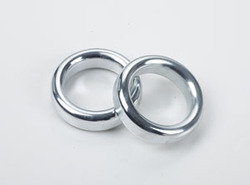
R-OVAL

Oval cross-section

R-oval ring joint gasket cross-section for comparison with R-octagonal
  • Fits only oval groove flanges
  • Line contact on the flange groove; contact line shifts with compression
  • Older flange designs; requires careful groove alignment
  • Readily available but not the first choice for new build piping
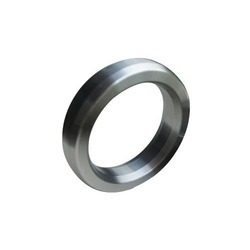
R-OCTAGONAL · this page

Octagonal cross-section

R-octagonal ring joint gasket 23 degree cross-section
  • Fits octagonal groove flanges, and replaces R-oval on the same nominal size
  • Two 23° flat faces form a controlled line contact that recovers better under pressure cycling
  • Standard profile for ASME B16.5, ASME B16.47 Series A, API 605
  • Higher sealing performance than R-oval at the same bolt load

Profile and tolerance at a glance

23° ± 0.5°Groove angle on the ring face
±0.2 mmRing width tolerance
±0.4 mmRing height tolerance
±0.18 mmPitch diameter tolerance

Dimensional tolerance and inspection

Swipe to view full table →

Dimension Tolerance Inspection method
Width of ring ±0.2 mm Calipers, three positions per ring
Height of ring ±0.4 mm Height gauge against the ASME B16.20 table
Pitch diameter ±0.18 mm Inside and outside micrometers
Groove angle 23° ± 0.5° Angle gauge, comparator
Surface condition Free of cracks, pits, tool marks and rust Visual, 100% inspection
Hardness Per material specification Portable hardness tester, batch record
Ring flatness Within 0.1 mm at the sealing face Surface plate and dial gauge

The ring hardness must stay below the flange groove hardness; if the ring is harder than the groove, the groove deforms first and the joint leaks. Dimensional records and hardness records travel with every batch. Third-party dimensional inspection is available on request for refinery and petrochemical packages.

Materials grouped by service

Carbon and soft iron – general service

Soft iron (90 HB), low carbon steel (120 HB). The default grades for Class 150–600 non-sour, non-oxidising service where the flange is carbon steel.

Stainless steel – chloride and process media

SS304, SS304L, SS316, SS316L, SS321, SS347, SS410, 310, 316Ti, 3CR12 and duplex, 160–170 HB. SS304 and SS316 are the everyday stainless grades; SS347 is used for high-temperature cycling; SS410 suits mild wear resistance.

Nickel alloys – high temperature, sour and aggressive media

Monel 400, Nickel 200, Inconel 600, Inconel 625, Inconel X-750, Incoloy 800, Incoloy 825, 150 HB typical. Sour service follows NACE MR0175 / ISO 15156, and the final grade depends on H2S partial pressure, chloride content and temperature. Send the media data and Kaxite will return a matching grade.

Specialty and non-metal

Hastelloy B2, Hastelloy C276, titanium, zirconium, copper, and PTFE (inner rings only, never as the R-octagonal sealing body). For seawater, strong acids, high-purity processes and other exotic media.

Flange standards and pressure classes covered

ASME B16.5 ASME B16.47 Series A API 605 BS 1560 BS 4504 BS 10 DIN NF JIS MSS SP-44 Class 150 – 2500 ASME B16.20

The R-octagonal profile covers the same flange range as R-oval. For API 6B flanges use RX; for API 6BX flanges and 16BX hubs use BX. See the RX ring joint gasket and BX ring joint gasket pages for those families, or the API ring joint gasket page for the full API range.

Where R-octagonal rings are specified

Refinery and petrochemical process piping
High-pressure steam and hydrocarbon service
Large-diameter ASME B16.47 Series A flanges
Valve bonnets and pressure vessel manways
Gas gathering and compression stations
Power generation feedwater and steam loops

Bulk supply, custom sizes and free samples

Kaxite Sealing machines R-octagonal ring joint gaskets in Ningbo, Zhejiang, on the same CNC line that produces R-oval, RX, BX and lens rings, so a mixed project package can be shipped from one facility with one set of certificates. Standard sizes follow the ASME B16.20 table. Non-standard groove dimensions and special alloy rings are quoted from drawings. Free samples are available for qualified projects, with the mill certificate attached to the sample shipment. Factory visits and video audits are welcome by appointment; ISO 9001 certificate details are available on request. For soft-gasket alternatives on non-RTJ flanges, compare the spiral wound gasket range.

Frequently asked questions

Can an R-octagonal ring replace an R-oval ring?
Yes. An R-octagonal ring of the same nominal size fits the same flange groove as the R-oval ring and provides a better sealing line on the octagonal faces. The only case where the R-oval must stay is an original oval-only groove that has never been machined to the octagonal profile; even then, most ASME B16.5 and B16.47 Series A flanges accept both.
What pressure class does R-octagonal cover?
The R-octagonal profile covers Class 150 up to Class 2500 on ASME B16.5 and ASME B16.47 Series A flanges. Above Class 2500 or on API 6B / 6BX wells, RX and BX rings take over. The BX family reaches 20,000 PSI.
Why is the ring hardness lower than the flange?
The metal-to-metal joint works because the ring deforms into the flange groove when the bolts are torqued. If the ring is harder than the groove, the groove deforms instead of the ring, the sealing line drifts and the joint leaks. That is why soft iron (90 HB) and low carbon steel (120 HB) are common on carbon steel flanges, and why the stainless and nickel grades are matched to the flange material.
What documentation ships with each ring?
Each R-octagonal ring ships with the mill certificate for the raw forging, a dimensional inspection record against ASME B16.20, and the KXT stencil on the ring face showing size, class, material and manufacturer mark. Hardness is verified batch by batch; the hardness record is available on request.
Do you provide free samples and factory audits?
Kaxite provides free samples for qualified projects, freight collect, with the matching mill certificate. Factory visits and video audits are welcome by appointment. ISO 9001 certificate details and the CNC machining records are available on request.

Request an R-octagonal ring joint gasket quote

Tell us flange size, pressure class, ring number, material grade and working media. Free samples and full dimensional records available for qualified projects.

Send Inquiry →
Send Inquiry
Contact Info
Rating:
5.0
X
We use cookies to offer you a better browsing experience, analyze site traffic and personalize content. By using this site, you agree to our use of cookies. Privacy Policy
RejectAccept