

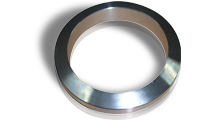
Kaxite lens ring joint gasket is a solid metal sealing ring with a spherical (ball-face) sealing surface, CNC-machined for high-pressure pipe flange connections in oil, gas, petrochemical and offshore service. Unlike ring joint gaskets that sit inside a machined groove, the lens ring seats directly between two conical flange faces: the spherical face contacts the cone along a circular line, then deforms plastically under preload to spread that line into a sealing band. This is a forced seal, so it is used where the design pressure is not lower than 10 MPa, with a practical service ceiling of 32 MPa. Standard supply is to ASME B16.20 and API 6A; DIN 2693-67, DIN 2696-1999 and JPI-7S-23-72 are also quoted on request. For the ring-groove families that cover lower pressures, see the ring joint gaskets parent page.
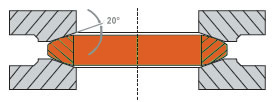
Before bolting, the spherical gasket face touches the conical flange face along a single circular line. No sealing area exists yet — this is the alignment reference.
As the bolts are torqued, the ring metal yields at the contact line. The line contact widens into a continuous band — the gasket is deliberately softer than the flange cone (15–20 HB below flange hardness) so the ring deforms, not the flange.
Once the band forms, the joint is pressure-energised. System pressure increases the contact stress on the band instead of opening it, which is why lens rings hold at 10 MPa and above where flat gaskets cannot.
If your flange groove is machined for a metal ring that sits inside the groove (R-oval, R-octagonal, RX or BX), the lens ring is not the correct part — it seats on a conical flange face, not in a groove. The R-oval ring joint gasket page covers the general R family; the RX ring joint gasket covers API 6B up to 5,000 PSI; the BX ring joint gasket covers API 6BX up to 20,000 PSI.
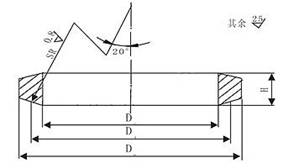
Open bore, used for pipe-to-pipe flange seals. The process fluid passes through the bore, and both spherical faces seat against the two flange cones on either side of the joint.
Solid disc with no bore, used for blind flange seals. It closes the line at the flange end and is machined from a solid forging so no bore needs to be finished.
Swipe to view full table →
| Parameter | Value | Notes |
|---|---|---|
| Gasket factor m | 5.50–6.50 | Used in bolted-flange design; higher than spiral wound gaskets |
| Minimum pre-tightening pressure y | 126.6–182.8 MPa | Required to form the sealing band |
| Service pressure | ≥10 MPa, ceiling 32 MPa | Below 10 MPa a ring-groove or spiral wound gasket is more economical |
| Service temperature | -196°C to 1000°C | Depends on the alloy — see materials table |
| Hardness rule | Ring 15–20 HB below flange cone | Ring must deform before the flange |
| Sealing type | Forced seal, line to band | Requires controlled preload; not a self-energising profile |
Soft iron, low carbon steel, F5, F11. Standard grades for non-sour oil, gas and steam service on carbon steel flanges.
SS304, SS316, SS321, SS347, SS410. Process and mildly corrosive media; SS347 for high-temperature cycling.
Copper, aluminium. Used where a soft, non-sparking ring is required; aluminium gives a lower hardness for delicate flange cones.
Monel 400, Inconel 600, Inconel 625, Incoloy 800, Incoloy 825, Nickel 200, Hastelloy C276, Zirconium 702. Sour, high-temperature, aggressive acids, seawater and high-purity processes. Sour service follows NACE MR0175 / ISO 15156; send the media and Kaxite will confirm the grade.
Kaxite Sealing machines lens ring joint gaskets in Ningbo, Zhejiang, on the same CNC line as the R, RX and BX ring joint gaskets, so a mixed HP project package can ship from one facility with one set of certificates. Standard sizes are quoted against ASME B16.20, API 6A, DIN 2693-67, DIN 2696-1999 and JPI-7S-23-72; non-standard sizes and special alloys are quoted from drawings. Free samples are available for qualified projects, with the mill certificate attached. Factory visits and video audits are welcome by appointment; ISO 9001 certificate details are available on request. For non-metallic soft gasket alternatives on lower-pressure flanges in the same project, compare the spiral wound gasket range.
Request a lens ring joint gasket quote
Tell us pipe size, design pressure, flange material and cone angle, ring material grade and working media. Free samples, dimensional records and mill certificates available for qualified projects.
Send Inquiry →Address
No. 432 Zhenhai Middle Road, Luotuo Street, Zhenhai District, Ningbo City, Zhejiang China


