Products
Double Jacketed Gasket

Double Jacketed Gasket

Kaxite double jacketed gasket is a soft-core gasket wrapped in a metal jacket for heat exchangers, boiler flues, pumps and valve bonnets. The jacket protects the core from the process fluid; the core gives the conformability a metal-only gasket cannot. Jackets in soft iron, SS304/316, copper, aluminium, Monel or titanium; cores in graphite, PTFE or ceramic. Thickness tolerance +0.8/-0.0 mm, OD/ID +1.5/-0.0 mm. Partition bars integrated or welded for heat exchanger pass partitions. ASME B16.5 Class 150–2500. Free samples from an ISO 9001 Ningbo factory.
Rating: 5.0
(Rating Count: 1)

Double Jacketed Gasket for Heat Exchangers and Boiler Flues – Metal Jacket with Soft Core

Kaxite double jacketed gasket is a soft-core gasket wrapped in a metal jacket. The metal jacket protects the core from the process fluid and provides the rigidity needed on flat face and raised face flanges; the soft core provides the conformability a metal-only gasket cannot. The jacket fully or partially encloses the core, and partition bars can be integrated or welded into the gasket for heat exchanger pass partitions. This is the gasket that makes heat exchanger channels, boiler flue ducts, pump casings, gas mains and valve bonnets seal reliably when the flange faces are wide and the media is corrosive. See the wider range on the double jacketed gaskets parent page.

The three-layer sandwich, layer by layer

Outer layer
Metal jacket — top wrapSeals the joint against the process fluid and gives the gasket its structural rigidity. Folded over the edge of the core so no soft material is exposed to the fluid.
Core
Soft compressible coreAbsorbs flange surface imperfections and thermal movement. Expanded graphite for steam and hydrocarbons, PTFE for acids and solvents, ceramic for high temperature.
Outer layer
Metal jacket — bottom wrapCompletes the enclosure. The two jacket halves are pressed over the core so the gasket thickness tolerance stays at +0.8 / -0.0 mm from edge to edge.

Two partition bar options for heat exchanger passes

Integrated partition bar

The bar is formed from the same jacket metal and pressed into the gasket during stamping. Fast to produce, suitable for small to medium pass bars where the bar stays within the gasket outline.

Welded partition bar

A separate jacket-metal bar is welded across the gasket face. Used for long pass bars, multiple passes and heat exchanger channel covers where the bar must transfer load between flanges.
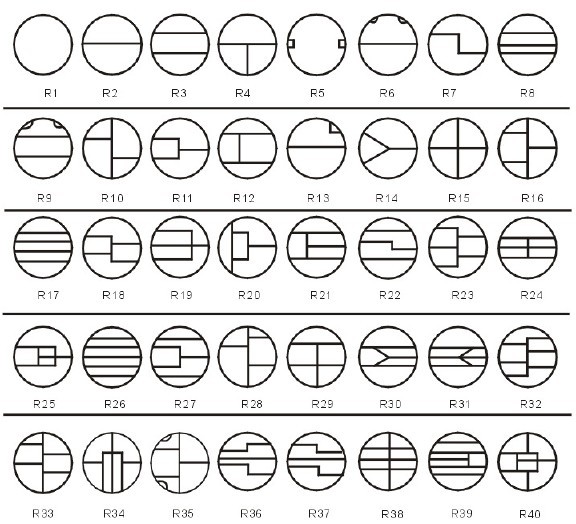
Jacket shapes

Double jacketed gasket jacket shapes for heat exchanger and boiler flue flanges
Standard jacket shapes: full jacket, partial jacket and pass-partition versions.

Tolerances that matter on a wide flange

+0.8 / -0.0 mmGasket thickness tolerance
+1.5 / -0.0 mmOD and ID tolerance, NPS 1/2–24
150–2500ASME B16.5 pressure class
NPS 1/2–24Standard size range (larger on request)

The thickness is held to a one-sided negative tolerance so the gasket never exceeds its nominal thickness on the bolts. On a heat exchanger channel with a long bolt circle, a 0.8 mm oversize gasket would change the bolt load distribution across the pass bars, so this tolerance is not a marketing claim — it is a fit requirement. The OD/ID tolerance is also one-sided negative, matching the ASME B16.5 flange bore so the gasket never sits proud of the raised face.

Standard dimension tolerances

Swipe to view full table →

Dimension Tolerance Applies to
Gasket thickness +0.8 mm / -0.0 mm All sizes
Outside diameter +1.5 mm / -0.0 mm NPS 1/2 – NPS 24
Inside diameter +1.5 mm / -0.0 mm NPS 1/2 – NPS 24
Partition bar thickness Matched to gasket Per drawing
Bolt-hole pitch Per ASME B16.5 flange Standard flanges

Non-standard sizes are quoted from drawings. For very large exchangers or non-circular shapes, Kaxite will issue a dimensional drawing before production; the customer signs off the drawing before material is cut.

Jacket and core materials

Jacket options

  • Soft iron
  • Low carbon steel
  • SS304, SS316, SS321, SS347
  • Nickel, Monel 400
  • Copper, aluminium, brass
  • Titanium

Core options

  • Expanded graphite
  • PTFE
  • Ceramic
  • Non-asbestos fibre
  • Mica
  • Combination of the above

The jacket and the core are chosen as a pair. A 316 jacket with graphite core is the default for steam and hydrocarbons; a 304 jacket with PTFE core suits acids and solvents up to 260°C; a stainless jacket with ceramic core handles boiler flue and high-temperature service. Send the media, temperature and flange material and Kaxite returns the pair.

ASME B16.5 class and size exclusions

Standard flange size/class limits that ASME B16.5 itself sets

  • There is no ASME B16.5 Class 400 flange for NPS 1/2 to NPS 3 — use Class 600 for those sizes.
  • There is no ASME B16.5 Class 600 flange for NPS 1/2 to NPS 2-1/2 — use Class 1500 for those sizes.
  • There is no ASME B16.5 Class 2500 flange at NPS 14 and larger.

These are ASME B16.5 standard limits, not Kaxite production limits. When a customer asks for a gasket in one of these excluded combinations, Kaxite supplies the gasket to the class the standard actually requires and records the class substitution on the dimensional drawing.

Applications

Shell-and-tube heat exchanger channels and covers
Boiler flue ducts and air preheaters
Gas mains and compressor station flanges
Pump casing and split-case joints
Valve bonnets and manway covers
Condenser water boxes and tube-sheet covers

On applications where the flange face is narrow or the media is high-pressure gas, a spiral wound gasket or a kammprofile gasket may be the better choice. The double jacketed gasket wins when the flange face is wide (heat exchanger channels, boiler flues, large vessel covers) and the process benefits from a metal-wrapped soft core.

Production, lead time and samples

Kaxite Sealing stamps and welds double jacketed gaskets in Ningbo, Zhejiang, on double jacketed gasket production equipment, so jacket stamping, core loading, edge folding and partition-bar welding stay in one facility. Standard sizes ship from stock against the ASME B16.5 table; non-standard sizes and pass partitions are quoted from drawings. Free samples are available for qualified projects with the mill certificate attached. Factory visits and video audits are welcome by appointment; ISO 9001 certificate details are available on request.

Frequently asked questions

What is the difference between a double jacketed gasket and a spiral wound gasket?
A double jacketed gasket is a wide-face gasket: a metal jacket wrapping a soft core, seating on the full flange face. It is used on heat exchanger channels, boiler flues, pump casings and vessel covers where the flange face is wide. A spiral wound gasket is a narrow-face gasket: a V-profile metal winding alternated with a soft filler, seating on a narrow raised face or in a tongue-and-groove groove. High-pressure gas and narrow raised faces favour spiral wound; wide flat faces and heat exchanger pass partitions favour double jacketed.
Why does the gasket need a partition bar?
Heat exchanger channels often carry more than one pass — the shell-side fluid may pass twice or four times across the tube bundle. The partition bar is a metal divider welded or integrated into the gasket that stops the fluid from bypassing between passes and from leaking across the pass divider at the flange. Without it, the exchanger loses thermal efficiency and the pass-to-pass pressure drop collapses.
Why are the thickness and diameter tolerances one-sided negative?
The tolerance is +0.8 / -0.0 mm on thickness and +1.5 / -0.0 mm on OD and ID. A gasket that is thicker than nominal will change the bolt load distribution across a long heat exchanger bolt circle; a gasket that is wider than nominal will sit proud of the flange face. A one-sided negative tolerance guarantees the gasket never exceeds the nominal dimension, so the bolt load is predictable at the design stage.
Which jacket and core combination should I choose?
The jacket must survive the media, and the core must survive the temperature. For steam and hydrocarbons: SS316 jacket with expanded graphite core. For acids and solvents up to 260°C: SS304 jacket with PTFE core. For boiler flue and high-temperature dry gas: SS321 or SS347 jacket with ceramic or mica core. For seawater and chloride: Monel or titanium jacket with PTFE core. Send the media, temperature and flange material and Kaxite will confirm the pair.
What documentation ships with each gasket?
Each gasket ships with the jacket material certificate, a dimensional inspection record against the referenced ASME B16.5 flange size and class, and the KXT stencil on the jacket edge. For heat exchangers with partition bars, a signed dimensional drawing is kept on file for the production lot. Factory visits and video audits are welcome by appointment; ISO 9001 certificate details are available on request.

Request a double jacketed gasket quote

Tell us flange size, ASME B16.5 class, jacket material, core material, gasket thickness and whether a partition bar is required. Free samples and dimensional drawings available for qualified projects.

Send Inquiry →
Send Inquiry
Contact Info
Rating:
5.0
X
We use cookies to offer you a better browsing experience, analyze site traffic and personalize content. By using this site, you agree to our use of cookies. Privacy Policy
RejectAccept